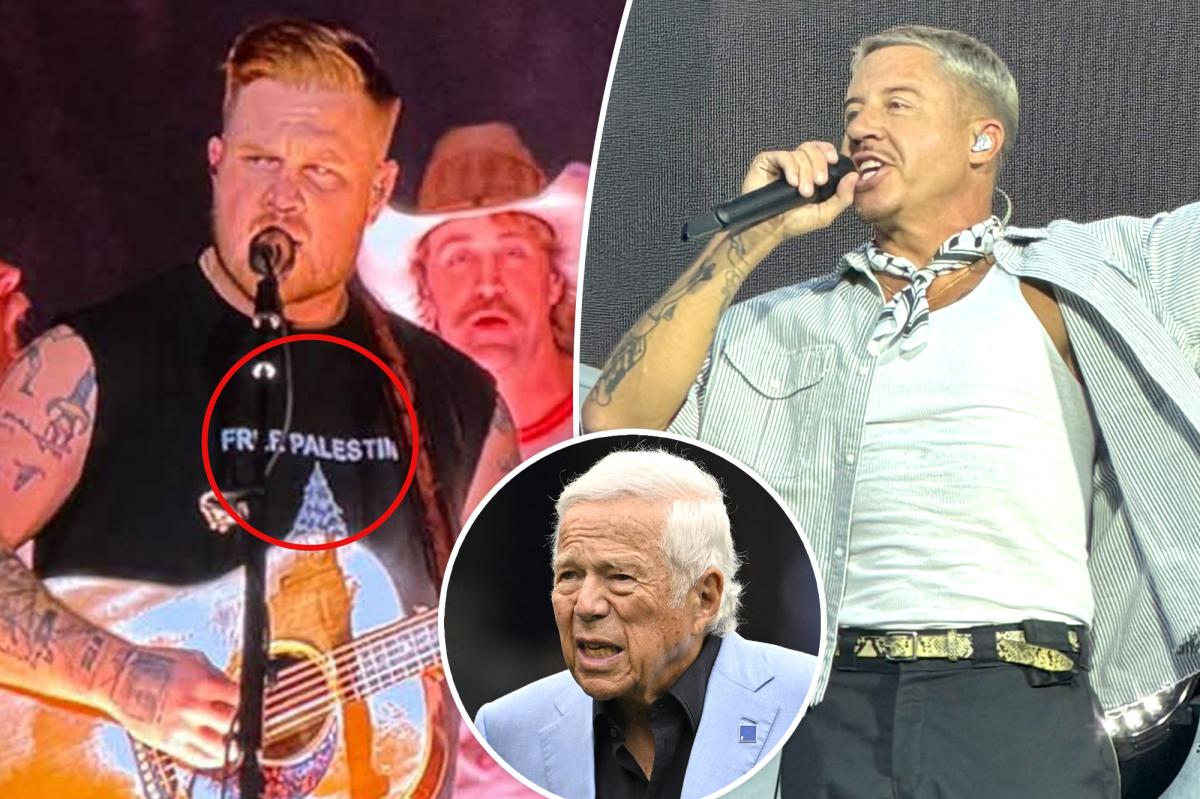
The roar that followed Zach Bryan’s entrance was immediate, a wave of cheers filling Gillette Stadium as the country singer stepped onto the field wearing a plain white tee emblazoned with the words “Free Palestine.” It was a moment that felt like a direct counterpoint to the drama that had unfolded there just weeks earlier, when the stadium’s owner, Robert Kraft, had barred rapper Macklemore from a scheduled performance over a heated anti‑Israel statement. The timing of the gesture, one month after the incident, made the stage look less like a backdrop for a musical set and more like a stage for an unspoken statement.
Bryan’s “With Heaven on Tour” tour had already earned him a Grammy and a reputation for authenticity that often spills into his lyricism. Yet the decision to display a politically charged slogan in a venue owned by a prominent Jewish NFL figure was a departure from the usual emphasis on music alone. The stadium’s own schedule confirmed that the singer performed on Friday and Saturday nights, while earlier weather‑induced cancellations had left fans disappointed and the venue’s calendar noticeably altered. In this new context, the simple shirt became a visual cue that sparked conversations long after the final chord.
Background & Context
Robert Kraft, the majority owner of the New England Patriots and proprietor of Gillette Stadium, had been under scrutiny after he announced that Macklemore would be excluded from a planned set. Macklemore had delivered a “Free Palestine” chant during a performance at MetLife Stadium and had played a track featuring Gaza footage, prompting Kraft to describe the act as “disruptive.” The ban was part of a broader pressure that reportedly also reached Ed Sheeran, who was asked to drop Macklemore from his own scheduled shows at the same venue. The owner’s stance placed the stadium in the middle of a high‑profile controversy that raised questions about free speech, artistic expression, and the responsibilities of venue operators.
Zach Bryan’s appearance at Gillette came a month after that conflict. While the stadium had been prepared for his performance, the atmosphere carried an undercurrent of tension that had not entirely dissipated. Bryan, a songwriter known for his raw storytelling, had not previously been associated with political activism in a public arena, making the “Free Palestine” shirt a stark departure from his usual onstage persona. The decision to wear it came amid a national conversation about the intersection of music and politics, especially as artists increasingly use their platforms to make statements on international affairs.
The timing also dovetails with the logistical challenges that the stadium faced earlier that week. Sheeran’s scheduled shows were cancelled due to inclement weather, leaving the venue’s calendar with gaps that were later filled by Bryan’s performances. The weather disruptions, the Macklemore controversy, and the sudden appearance of a politically loaded shirt all converged into an event that drew more attention than a typical concert might have. Gillette’s official schedule had not mentioned any political statements, and no spokesperson had yet issued an explanation for Bryan’s choice of apparel.
What People Are Saying
The crowd’s immediate reaction was a mixture of applause and murmurs that carried a sense of solidarity with the shirt’s message. Some concertgoers took to social media, posting videos of the moment and expressing their support for the artist’s decision to use the platform to highlight a cause. Others voiced concerns about the stadium’s policies and how they relate to freedom of expression, pointing out the contrast between the ban on Macklemore and the acceptance of Bryan’s statement. Fans who have followed Bryan’s work for years noted that his lyrical honesty has always pushed against comfort zones, and the shirt was seen as an extension of that authenticity.
In the broader conversation, critics have weighed in on the complexities of venue ownership and artistic freedom. Observers noted that Robert Kraft’s decision to block Macklemore was not without precedent; venues often have codes of conduct that can limit performers’ political messaging. Yet the absence of a similar response to Bryan’s shirt raised questions about consistency. Some commentators pointed out that the context mattered: Macklemore’s chant occurred during a performance that included Gaza footage, whereas Bryan’s shirt was simply a statement of solidarity without a performance element tied to the conflict.
Public officials and representatives for the stadium have yet to respond. As a result, the conversation has largely remained in the realm of fan discourse, with individuals using the event as a catalyst to discuss broader issues of free speech, sports ownership, and the role of entertainment spaces in political dialogues. The tension between maintaining neutrality as a venue and allowing artists to express personal convictions is now a focal point of discussion among industry observers.
What Happens Next
The ripple effects of the shirt’s appearance are likely to extend beyond the night of the concert. Gillette Stadium’s decision-making process regarding future bookings may come under closer scrutiny, with artists and booking agents evaluating the venue’s policies in light of the recent controversy. Artists who previously avoided political statements at the stadium might reconsider, while others may see an opening to use the platform more openly. The conversation about whether sports venues should be neutral arenas or cultural stages for protest is poised to intensify.
Bryan’s own trajectory may also shift. While his music continues to focus on personal and emotional narratives, this move could broaden his audience to include listeners who identify with social justice causes. Record labels and promoters may monitor audience reception and engagement metrics to gauge how political statements influence ticket sales and streaming figures. Whether the “Free Palestine” shirt will become a catalyst for more overt political activism in Bryan’s future performances remains to be seen, but the event has already opened a dialogue about the boundaries of expression in large venues.
Finally, the broader industry might use this moment as a case study. Producers and venue owners are likely to revisit their policies on performer conduct, especially as fans and the public increasingly demand authenticity and social responsibility from the artists they support. The balance between creative freedom and venue policies will be a topic of negotiation in upcoming contracts, and the incident at Gillette may serve as a benchmark for what is considered acceptable.
The night ended with the stadium’s lights dimming, the echoes of applause lingering, and a lingering question: will the space that once hosted a controversial ban now become a stage for a different kind of statement? In any case, Zach Bryan’s choice of attire has already etched itself into the narrative of the venue, reminding everyone that music, even in a stadium, can still be a vessel for messages that ripple beyond the stage.
Read more celebrity news at MyWorldPulse.