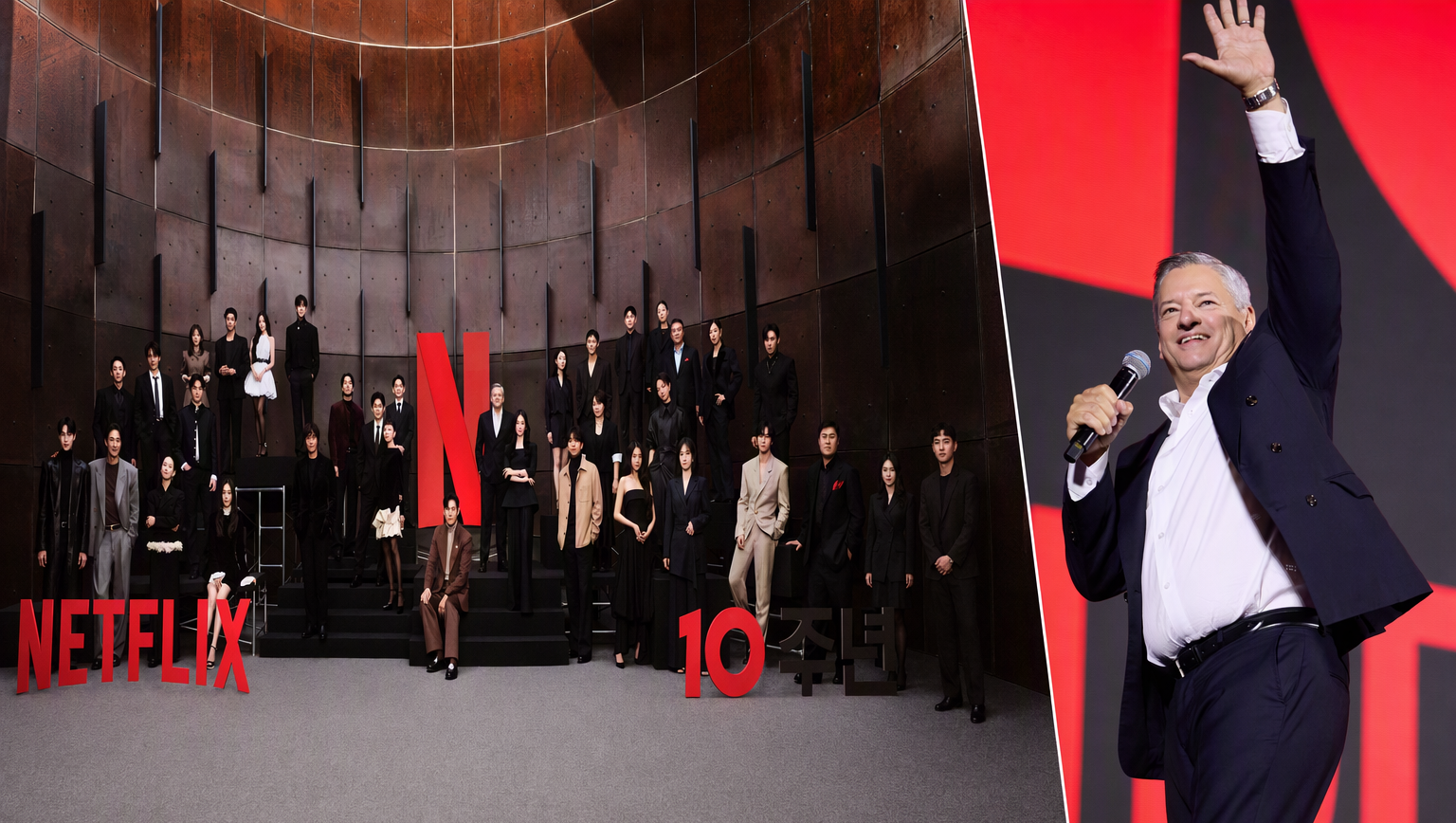
When Ted Sarandos, Netflix’s co‑chief content officer, stepped onto the stage in Seoul this weekend, he did more than just deliver a greeting – he lit up the city with a palpable sense of celebration. The 55‑year‑old CEO’s presence underscored a milestone that resonates far beyond Korean borders: a full ten years of Netflix’s imprint on the nation’s entertainment landscape. In a region that has long been a crucible for global pop culture, the anniversary carried a weight that matched the hype of a blockbuster premiere.
The festival, which stretched over two days, drew fans from all walks of life to a sprawling venue in the heart of Seoul. Celebrities who helped catapult Netflix into the Korean zeitgeist, such as the cast of “Squid Game” and “KPop Demon Hunters,” joined Sarandos for a mix of panels, performances, and fan interactions. The event was not merely a party; it served as a showcase for the next wave of titles, including the much‑anticipated “Possible Love,” “Tantara,” and the anime‑style adaptation of “Solo Leveling.” By aligning these releases with a high‑profile celebration, Netflix reaffirmed its commitment to keeping Korea at the center of its global strategy.
Background & Context
Netflix first entered the South Korean market in 2014, a move that came at a time when local broadcasters were still heavily dominated by state‑run networks. The platform’s willingness to invest in Korean original programming quickly paid dividends. In 2019, the streaming giant released “Squid Game,” a series that not only shattered viewing records but also sent shockwaves through international media, proving that Korean storytelling could command worldwide attention. By that point, Netflix’s Korean originals had already begun to rival the production values of traditional Hollywood fare, offering a fresh narrative perspective that resonated with diverse audiences.
The past decade has seen a convergence of forces that have amplified Korea’s cultural export power. K‑pop idols, Korean dramas, and film have built a dedicated global fanbase, often referred to as the “K‑wave.” Within this ecosystem, Netflix has played an outsized role, providing the infrastructure and distribution reach that allows these stories to cross linguistic and geographic boundaries. However, this ascent has not been without competition. Local streaming services such as Disney+ Hotstar and Apple TV+ have launched Korean originals, sparking a content arms race that has pushed all players to elevate production quality and storytelling depth. Against this backdrop, the 2024 anniversary event was not merely a celebratory nod; it was a reaffirmation of Netflix’s dominance in a rapidly evolving market.
The company’s growth has also had a ripple effect on Korea’s entertainment industry. The rise in demand for high‑budget productions has spurred investment in technology and talent development. As a result, more Korean writers, directors, and actors are gaining opportunities to work on projects with international reach. Netflix’s continued presence has become a benchmark for the success of digital streaming, encouraging domestic studios to adopt new distribution models and storytelling techniques. In this sense, the platform’s ten‑year celebration is a milestone that reflects a broader transformation in how Korean narratives are created, funded, and shared worldwide.
What People Are Saying
Attendees at the festival expressed a mixture of excitement and admiration for the platform’s trajectory. Fans who had followed “Squid Game” from its release to its global fandom reported that the live event felt like a collective celebration of a shared cultural moment. Some participants took to social media, posting photos of the stage set, Sarandos’s charismatic speeches, and the live performances by Korean idols. The energy in the venue was palpable; the crowd’s enthusiasm echoed the broader sentiment that Netflix had become a cultural touchstone in Korea.
Industry insiders commented on the strategic implications of the event. Commentators highlighted the significance of previewing titles like “Possible Love” and “Tantara,” noting that their early exposure could set a new standard for Korean originals. These shows, blending romance with sci‑fi and historical drama, respectively, demonstrate Netflix’s willingness to diversify its Korean slate beyond the gritty realism that defined “Squid Game.” The inclusion of “Solo Leveling,” a popular webtoon adaptation, further signaled the platform’s commitment to bridging popular digital culture with mainstream television.
The presence of Korean artists and actors alongside Sarandos also underscored the collaborative nature of the industry. For instance, the cast of “KPop Demon Hunters” shared candid moments, indicating a growing camaraderie between Korean talent and the streaming giant. Even local media coverage portrayed the event as a watershed moment for Korea’s entertainment ecosystem, one that could influence future licensing deals and international co‑productions. While some critics warned that Netflix’s dominance might stifle local creativity, many applauded the platform’s investment in Korean content as a catalyst for artistic growth and global recognition.
What Happens Next
Following the festival, Netflix is poised to roll out its upcoming Korean slate with a coordinated global launch strategy. “Possible Love,” slated for mid‑2025, is expected to push the boundaries of genre hybridity, while “Tantara” aims to showcase Korean historical storytelling on a grand scale. Meanwhile, “Solo Leveling” will adapt the beloved webtoon into a high‑budget, high‑glamour production that could attract both existing fans and new viewers worldwide. These releases will likely be supported by targeted marketing campaigns that emphasize Korean culture’s unique flavor, reinforcing the platform’s identity as a gateway to international content.
Beyond new titles, Netflix may leverage its Korean partnership network to forge deeper ties with local studios. Rumors have surfaced about potential co‑production agreements that would allow Korean creators to maintain creative control while benefiting from Netflix’s distribution clout. Such deals could democratize content creation, ensuring that future projects remain authentic and reflective of Korean society. Moreover, Netflix’s investment in production infrastructure—like the recent opening of a Korean office focused on content development—signals a long‑term commitment that transcends mere market share.
Industry analysts predict that this momentum will influence competitors as well. With Disney+ and Apple TV+ already stepping into the Korean content arena, Netflix’s continued dominance could prompt these rivals to accelerate their own local production strategies. The result may be a more vibrant, diversified marketplace where Korean narratives find multiple avenues to reach global audiences. At the same time, Netflix’s success could serve as a blueprint for other regions, illustrating how strategic investment in local culture can yield global dividends.
The anniversary event also hinted at Netflix’s broader vision: to blend local storytelling with universal themes. By spotlighting Korean narratives that resonate on a global scale, the platform demonstrates how cultural specificity can coexist with mass appeal. This balance has been key to Netflix’s worldwide growth, and its Korean strategy exemplifies that formula in action. As the platform prepares to launch new titles and expand its production footprint, the industry watches closely to gauge how these moves will shape the future of streaming in Korea and beyond.
The festival’s closing ceremony, marked by a fireworks display over Seoul’s skyline, left an indelible impression on both participants and onlookers. It was more than a celebration; it was proof of a decade of cross‑border storytelling that has reshaped the entertainment industry. For Netflix, the event reaffirmed its position as a cultural conduit, while for Korea, it highlighted the power of local narratives to command global attention. In a world where digital platforms increasingly define cultural consumption, this milestone signals that the next chapter in global streaming will be written in Korean, English, and every other language in between.
The Bottom Line
Netflix’s ten‑year Korean celebration is a bold statement of intent—an affirmation that the company will continue to invest heavily in local talent and content, while simultaneously shaping the global streaming agenda. By spotlighting Korean dramas, K‑pop, and webtoon adaptations, Netflix is not only diversifying its portfolio but also setting a new benchmark for authenticity and production quality. This move reasserts its leadership against a backdrop of intensifying competition from Disney+, Apple TV+, and other domestic services that are now racing to produce their own Korean originals. For the broader industry, Netflix’s strategy signals that streaming giants will only deepen their local ties if they can translate regional stories into universal themes. That is a dangerous game for domestic creators, who risk losing creative control if they fall into the same distribution model that prioritizes scale over nuance. Nonetheless, the festival’s success showcases a rare synergy between local artistry and global reach, illustrating how a streaming platform can catalyze cultural export while still delivering binge‑worthy content to millions. It’s a testament to the power of media to bridge borders and a warning to competitors that they must either adapt or be left behind.
- MyWorldPulse.com
Reference:
- Official post on the person's verified social media account
Read more celebrity news at MyWorldPulse.