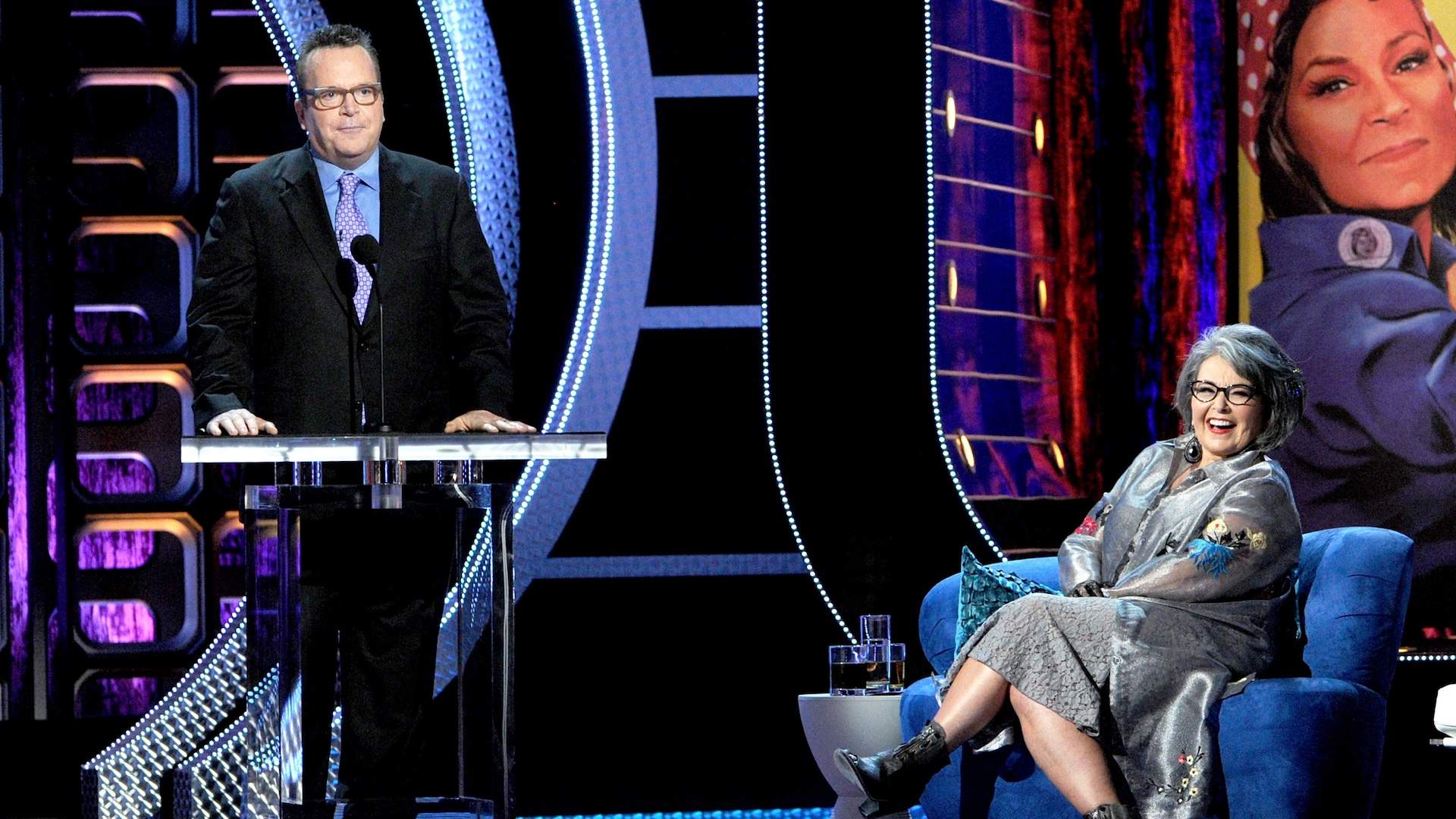
Roseanne Barr’s voice crackled over the phone, “I don’t think you’ll hear me say this often,” as she laughed, and with that, a decade‑old feud that had once seemed unbreakable began to thaw. For years the former sitcom co‑stars – the dynamic couple who were both the face and engine of the 1990s hit “Roseanne” – had exchanged barbs that kept tabloids glued to their headlines. Now, after a provocative memoir by legendary sitcom producer Chuck Lorre, Arnold has taken a surprisingly supportive stance toward his ex‑wife, offering a glimpse of the first time a former partner has spoken publicly in her favor.
In the 1990s, the marriage of Roseanne Barr and Tom Arnold became as headline‑making as the show itself. The couple, who married in 1993 and divorced in 1999, had spent the early 2000s living on the opposite sides of a legal battlefield that saw them trade lawsuits, public apologies and bitterly worded statements. Their relationship was further complicated by the fact that Arnold had been a writer and performer on “Roseanne,” while Barr had taken the show’s title character and turned it into a brand that satirized the American working class. The public’s fascination with their personal drama mirrored the way the sitcom portrayed the struggles of a blue‑collar family, making their split feel almost inevitable.
The current turning point began with the publication of Chuck Lorre’s memoir, “Sitcom: A Memoir,” in which the long‑time producer recounted his tenure as head writer on “Roseanne.” In a candid passage, Lorre revealed that Barr had long disliked the involvement of writers, stating that she “hated that there were writers. Fundamentally hated that other people wrote words that she would say.” Lorre explained that Barr had built the character of Roseanne Conner largely on her own persona, so the idea of letting others craft her lines felt like a betrayal. Yet, Lorre added that Barr’s frustration was not directed at all writers – she “only liked the funny writers,” a nuance that would prove pivotal in the unfolding drama.
Arnold, who had seen the same writers’ room dynamics up close, stepped forward to defend Barr’s position. In an interview with Entertainment Weekly, he called Lorre’s comments “a little oversimplified.” “Now, a couple of things,” he began, his tone laced with sarcasm. “He’s got Roseanne all figured out,” he joked, referring to Lorre’s intimate knowledge of the show’s narrative arc. “I hate to speak for her, but it’s not that she didn’t like writers,” Arnold continued. “She only liked the funny writers. That’s really the truth.” He went on to describe the tension in the writers’ room, where Lorre would stay late to shepherd the script, a practice Arnold claimed stifled creative freedom. “If you can’t figure it out by 10:30, I mean, these people have families,” Arnold said, underscoring the practical frustrations that had plagued the team. His remarks, which also noted that Lorre had been teased by colleagues for never laughing—so much so that he was nicknamed “Chuckles” behind his back—cast the former husband in a surprisingly sympathetic light.
Background & Context
The drama that erupted between Barr and Arnold has its roots in the very structure of “Roseanne.” The sitcom’s format relied heavily on the collaboration between the star’s improvisational instincts and the seasoned writing staff that crafted the show’s social commentary. Barr’s claim that she favored only the comedic writers echoes the show’s blend of humor and grit. The memoir’s passage about her disdain for non‑comedic writers illustrates how the creative process had become a battleground, not just for script ideas but for artistic ownership. Lorre’s recollection that he had spent countless hours in the writers’ room, sometimes late into the night, highlights the intensity of the creative environment and the personal toll it took on all involved.
Arnold’s willingness to speak out in defense of Barr is particularly notable when considered against the backdrop of their high‑profile divorce. The two had been engaged in a legal war that spanned years, culminating in a 1999 lawsuit in which Arnold sought custody of their children and argued for the fair distribution of their combined assets. Both have maintained that they had never spoken on each other’s behalf publicly. In this context, Arnold’s comments are the first time he has acknowledged the complexity of Barr’s feelings toward the writers, and the first time he has publicly countered Lorre’s portrayal of her.
In addition to the creative conflict, the memoir also touched on personal aspects of Barr’s life. Her decision to pursue a self‑financed TV comeback with “Meemaw” has re‑ignited discussions about her career and her willingness to return to the public eye. The memoir, and Arnold’s comments, appear to be an attempt to frame Barr in a more sympathetic light, potentially smoothing the way for future projects. This shift also coincides with a broader industry trend in which former rivals are more openly acknowledging past grievances, perhaps recognizing that collaborative histories can be leveraged for new ventures.
What People Are Saying
Barr’s reaction to Arnold’s defense was immediate and heartfelt. In a recent interview with a news outlet, she acknowledged the surprise of hearing her former husband speak positively about her. “Unbelievably – I don’t think you’ll hear me say this often – but Tom Arnold is telling the truth for once,” she said, her voice carrying a mixture of gratitude and disbelief. “Talk about the paradigm switch here. Tom Arnold is defending me. I have to thank him for that. That’s the first time he’s done something right by me in his life. Thanks, Tom.” The phrasing underscores how rare it is for Arnold to publicly praise Barr, suggesting that this public statement may represent a significant pivot in their relationship.
Arnold’s subsequent Instagram post, meanwhile, added a touch of humor to the evolving narrative. “Don’t give up. Don’t ever give up,” he wrote, followed by a cryptic reference to a “cool thing” he predicted would happen 33 years earlier. His post, which included an image of a smiling Arnold and a caption that seemed to reference a past prediction, was interpreted by many fans as a playful nod to the long‑standing drama and an affirmation of their newfound cordiality.
Fans and observers have responded with a mix of skepticism and optimism. Some see the exchange as a strategic move that could open the door to future collaborations between the two. Others view it as an opportunity for closure, allowing both parties to move beyond a public feud that had long dominated the cultural conversation. The broader entertainment community has also weighed in, noting that the show’s revival efforts might benefit from a more unified front, especially as the network landscape increasingly rewards nostalgia coupled with a willingness to reinterpret past controversies.
Industry insiders suggest that the memoir’s revelations, coupled with Arnold’s defense, might signal a shift in how former sitcom heavyweights approach retrospectives. Chuck Lorre’s book has already prompted discussions about the creative dynamics of long‑running sitcoms, and the candidness with which Arnold discusses those dynamics may encourage other writers and actors to reevaluate the collaborative process. As more industry veterans open up about their past working relationships, the possibility of reconciling former rivals could become more common, offering a fresh take on the way the industry remembers its past.
What Happens Next
With the conversation open, the future trajectory of Barr and Arnold’s relationship remains uncertain, but the recent dialogue suggests a more collaborative possibility. Barr’s upcoming “Meemaw” series is poised to bring her back to the screen, and rumors have floated that she might consider bringing Arnold into the project in some capacity. Whether that means a guest appearance, co‑writing credit, or even a behind‑the‑scenes role remains to be seen, but the groundwork for a partnership has been laid.
Meanwhile, Chuck Lorre’s memoir has become a point of reference for many aspiring writers, and it has likely spurred introspection within the writer’s room culture. Lorre’s own reflections on the dynamics of “Roseanne” may influence how future sitcoms structure their writing teams, especially when the lead actors are known for strong creative visions. The memoir’s focus on the tension between actors’ personal narratives and collaborative script work has sparked debate on whether a more inclusive approach could alleviate such friction.
Beyond the specific individuals involved, the entire narrative has implications for how the industry manages public relationships among its talent. The decision of a former spouse to publicly defend a former partner could be a case study in turning a once‑negative dynamic into a potentially productive partnership. Producers and networks may look to this example as evidence that a history of public feuds can be transformed into a narrative of reconciliation, benefiting both the involved parties and the audience’s appetite for familiar faces.
In the immediate term, fans will continue to monitor the social media feeds and interview releases from both Barr and Arnold. While no formal partnership has been announced, the public statements hint at a willingness to move past old grievances. Whether this translates into tangible creative output remains to be seen, but the dialogue itself has already begun to reshape how the former sitcom duo are perceived. In an industry that thrives on both nostalgia and innovation, this newfound openness could prove to be the catalyst for a fresh chapter in their shared story.
The next few months will reveal whether the thaw is merely a diplomatic courtesy or the first step toward a more substantive collaboration. In any case, the narrative that has once defined their relationship is now being rewritten, and the world of television will watch closely to see where it leads.
The Bottom Line
The sudden public defense by Tom Arnold marks a pivotal moment not just for the former Roseanne duo but for the television industry at large. By stepping forward, Arnold breaks the longstanding narrative that their split was irreparable, suggesting that even the most publicized feuds can be rewritten. This gesture opens a door—albeit a tentative one—to collaborative ventures that could benefit both parties and their audiences. It also challenges the industry to reexamine how personal dynamics are negotiated behind the scenes. If this thaw matures into a creative partnership, it could set a new standard for how former rivals navigate their shared histories. MyWorldPulse believes that what matters most is whether this newfound openness translates into tangible projects, offering a fresh, relatable storyline for viewers who crave both nostalgia and authentic human connection. The world of television will watch closely to see whether the reconciliation sparks a new chapter in this once‑turbulent relationship.
Reference:
- Tom Arnold’s verified Instagram post
Read more celebrity news at MyWorldPulse.